|
|
|
The Chagos
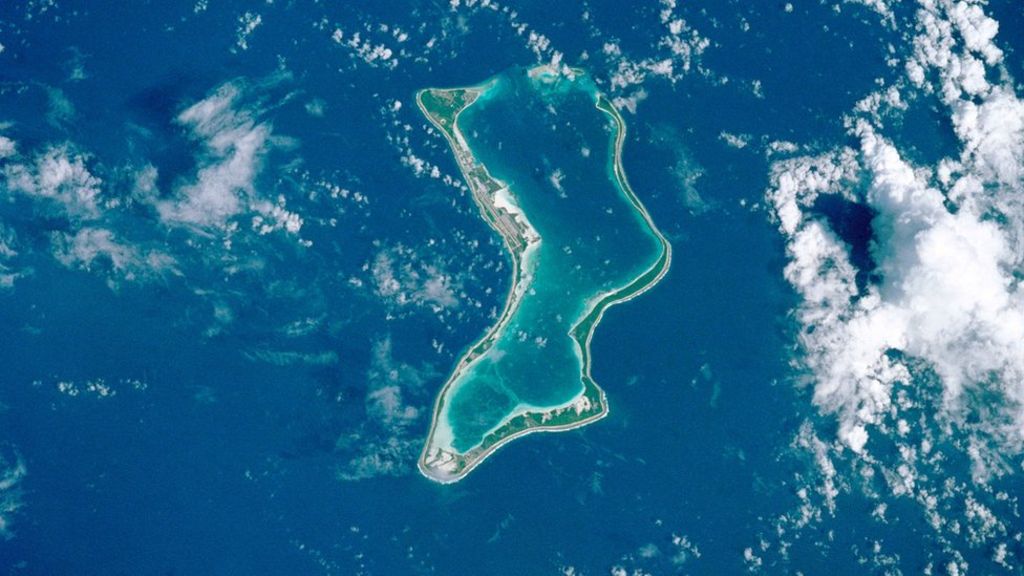
The Chagos and Maldives chain of islands was created after India slid north, millions of years ago, crumpling up the Himalayas in front of it. Upwelling lava from a hotspot deep in the earth’s mantle created the bases of these islands; those of Chagos were pushed up 45 million years ago. The islands’ lava cores then began their long, slow subsidence, while reefs from the remains of living coral built up around them. Amazingly, the coral under Diego Garcia is about a mile deep.
In 1965 the Chagos Islands were detached to become part of the British Indian Ocean Territory, with the full agreement of the Mauritius Council of Ministers and a grant paid to Mauritius, The Territory is administered by the UK Government through the BIOT Administration. There are no economic activities on the islands. UK/US Agreements regulate the use of the Territory for defence purposes only.
Geographic Coordinates
Latitude/Longitude (Diego Garcia)
06º 34' S, 72º 24' E
Relative Location B.I.O.T. is in both the eastern and southern hemispheres, just a few degrees south of the Equator. It's positioned in the Indian Ocean approximately 1,000 miles southwest of India.
Land Statistics
Coastline 432 miles (698 km)
Land Areas
(land) 23 sq miles (60 sq km)
(water) 0 sq miles (0 sq km)
(TOTAL )23 sq miles (60 sq km)
Land Area (all countries) here
Land Area 60 sq km (23 sq miles)
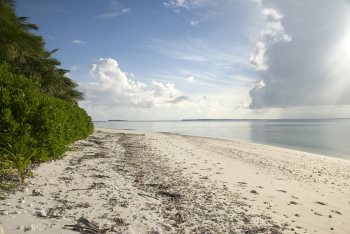
Landforms All of the islands are flat coral atolls with no lakes or rivers.
Highest Point on Diego Garcia - 49 ft. (15 m)
Lowest Point Indian Ocean - 0 ft. (0 m)

|
|
|
|
|
|
|
|
|
Chagos Island Marine Reserve
|
You are here: Home > Marine Conservation > Chagos Islands
The Marine Conservation Society and other leading scientific and conservation organisations from around the world had been calling on the UK government to establish a protected area in the British Indian Ocean Territory (BIOT), which is made up of the Chagos Islands and its surrounding waters.
During April 2010, the UK goverment declared the Chagos Archipelago a fully marine protected area (MPA) and the UK then became responsable for one of the largest coral reefs in the world. The Chagos Islands possess a wealth of wildlife, and are special above all for their coral; they contain some of the world's healthiest surviving coral reefs, which hold at least 220 coral species and up to 1,000 species of fish. The islands are a refuge and breeding ground for large and important populations of sharks, dolphins, marine turtles, rare crabs, birds and other vulnerable ocean and island species.
The Chagos Archipelago is a group of seven atolls comprising more than 60 individual tropical islands in the Indian Ocean; situated some 500 kilometres (310 mi) due south of the Maldives archipelago. This chain of islands are the Southern most archipelago among the Lakshadweep-Maldives-Chagos group of islands, which are in reality the tops of a vast undersea submarine mountain range, in the Indian Ocean and the Arabian Sea. The islands and their surrounding waters, form a vast oceanic Environment Preservation and Protection Zone (EPPZ) (Fisheries Conservation and Management Zone (FCMZ) of 544,000 square kilometres (210,000 sq mi)), an area twice the size of the UK's land surface.
Officially part of the British Indian Ocean Territory, the Chagos were home to the Chagossians for more than a century and a half until the United Kingdom evicted them in the early 1970s in order to allow the United States to build a military base on Diego Garcia, the largest of the Chagos Islands. Since 1971, only the atoll of Diego Garcia is inhabited, and only by military and civilian contracted personnel.
The Chagos group is a combination of different coralline structures topping a submarine ridge running southwards across the centre of the Indian Ocean, formed by volcanoes above the Réunion hotspot. Unlike in the Maldives there is not a clearly discernible pattern of arrayed atolls, which makes the whole archipelago look somewhat chaotic. Most of the coralline structures of the Chagos are submerged reefs.
The Chagos contain the world’s largest coral atoll (The Great Chagos Bank) and the greatest marine biodiversity in the UK by far. It also has one of the healthiest reef systems in the cleanest waters in the world, supporting half the total area of good quality reefs in the Indian Ocean. As a result, the ecosystems of the Chagos have so far proven resilient to climate change and environmental disruptions.
The reserve covers a 545,000-sq-km area around the Indian Ocean archipelago, regarded as one of the world's richest marine ecosystems.
This will include an area where commercial fishing will be banned.
But islanders, who were evicted to make way for the US air base on the island of Diego Garcia, say a reserve would effectively bar them from returning.
UK Foreign Secretary at the time of the reserves creation David Miliband said establishing the reserve would "double the global coverage of the world's oceans under protection". He commented: "Its creation is a major step forward for protecting the oceans, not just around BIOT [British Indian Ocean Territory] itself, but also throughout the world. "This measure is a further demonstration of how the UK takes its international environmental responsibilities seriously."
|
In marine terms, British Indian Ocean Territory is by far the most wildlife-rich part of the UK and all its overseas territories; the archipelago is isolated and at the very centre of the Indian Ocean where it acts as an "oasis" for species which are in decline or under pressure else where in the region, from the effects of population growth and development. The fact that 54 of the 55 islands are uninhabited (the exception being Diego Garcia with its US base) is undoubtedly a major reason why the ecosystem has remained so unspoiled.
The Chagos Protected Area will provide an important global reference site for a wide range of scientific ecological, oceanographic and climate studies, and will underpin the provision of benefits to humans throughout the Indian Ocean region into the future.”
Scientific research indicates that 90 percent of the ocean’s largest fish have disappeared over the past five decades by commercial fishing, and the hunt for what remains continues unabated. As a result, the world’s oceans are facing a crisis. No-take marine reserves are scientifically proven to be an effective tool to protect and restore marine ecosystems and the species they support.
“Tens of thousands of ray fish and sharks which are listed as threatened or near threatened on the International Union for Conservation of Nature’s Red List are accidentally caught and killed by fisheries in the Chagos every year,” said Dr. Heather Koldewey, Marine and Freshwater Conservation Programme Manager, Zoological Society of London. “The U.K.’s decision to create a Chagos Protected Area will stop this waste and provide a crucial safe haven for species such as tuna, billfish, and sharks to recover from systemic overfishing and for the turtles, corals and other sealife of this fabulous area to thrive.”
Conservationists say the combination of tropical islands, unspoiled coral reefs and adjacent oceanic abyss makes the area a biodiversity hotspot of global importance.
The purity of the water around Chagos has given its coral reefs protection against the warming that has killed much of the coral in the Indian Ocean. Since the islands straddle currents that pass to both east and west, they offer hope that its corals could recolonise the damaged reefs of other Indian Ocean nations.
The archipelago, which has been compared to the Galapagos Islands and to Australia's Great Barrier Reef, hosts the world's biggest living coral structure - the Great Chagos Bank. This is home to more than 220 coral species - almost half the recorded species of the entire Indian Ocean, and more than 1,000 species of reef fish.
Highlights include:
Coconut crab (Birgus latro)
The world's largest land arthropod, with a leg span of over 3ft and a weight of up to 9lb, this crab can climb trees and even crack a coconut with its massive claws. It is now rare in most of the tropical areas where it is found, but the Chagos population is undisturbed and healthy. |
 |
Cuvier's beaked whale (Ziphius cavirostris indicus)
Also known as the goose-beaked whale, this mammal was thought in the Middle Ages to have a fish's body and an owl's head. Can live up to 40 years and grow to seven metres long. Their range is known mainly from strandings. It is widespread across the Atlantic, Pacific and Indian Oceans. Individuals have been found as far north as the Shetland Islands and as far south as Tierra del Fuego. Deep waters are preferred in anything from cool to tropical habitats.
|

|
Grey reef shark (Carcharhinus amblyrhynchos)
Is one of the most common reef sharks in the Indo-Pacific, it is found as far east as Easter Island and as far west as South Africa. This species is most often seen in shallow water near the drop-offs of coral reefs. The grey reef shark has the typical "reef shark" shape, with a broad, round snout and large eyes.
In the Indian Ocean, shark numbers are down about 90 per cent over the last 30 years because of overfishing (especially for shark fin soup), and such a decline is also evident in Chagos waters. Conservationists think that making the islands a no-fishing zone could help them recover.
|
 |
Emperor angelfish (Pomacanthus imperator)
The coral reefs of the Chagos archipelago hold up to 1,000 fish species, many of them dazzlingly coloured, including clownfish, triggerfish and several species of angelfish.
The Emperor Angelfish is a reef-associated species. Juveniles prefer to stay hidden under ledges or inside holes of outer lagoon patch reefs or semi-protected areas of exposed channels and outer reef flats. As they grow older, they move to holes located at reef fronts and in surge cannels. |
 |
Masked booby (Sula dactylatra)
The islands are an enormously important seabird refuge, with 17 species nesting there, often in large colonies, ranging from the masked booby to the red-tailed tropic bird, and from the great frigatebird to the sooty tern.
The Masked Booby nests in small colonies, laying two chalky white eggs on sandy beaches in shallow depressions, which are incubated by both adults for 45 days. In most cases, the first chick will kill its smaller, weaker sibling after it hatches.Siblicide has been well studied in this species; researchers such as David Anderson have demonstrated that while the boobies can manage to feed two chicks if siblicide is prevented, they do so at a steep penalty to health and future reproductive success. |
 |
Red-footed booby (Sula sula)
This seabird is the smallest of all the boobies, with distinctive red legs and pink and blue bill and throat. The spectacular diver has elaborate greeting rituals between mates.
This species breeds on islands in most tropical oceans. When not breeding it spends most of the time at sea, and is therefore rarely seen away from breeding colonies. It nests in large colonies, laying one chalky blue egg in a stick nest, which is incubated by both adults for 44–46 days. The nest is usually placed in a tree or bush, but rarely it may nest on the ground. It may be three months before the young first fly, and five months before they make extensive flights. |
 |
Green turtle (Chelonia mydas)
Endangered; feeds mostly on seagrass; has found the waters around the Chagos Islands a haven. Elsewhere, it has suffered from habitat loss, pollution and fishing nets.
In the Pacific, its range reaches as far north as the southern coast of Alaska and as far south as Chile in the east. The turtle's distribution in the Western Pacific reaches north to Japan and southern parts of Russia's Pacific coast and as far south as the northern tip of New Zealand and a few islands south of Tasmania. The turtles can be found throughout the Indian Ocean. |

|
Hawksbill turtle (Eretmochelys imbricata)
This turtle is the principal source of tortoiseshell material; it has been over-hunted all around the world and is critically endangered. But the atolls of the Chagos are perfect breeding and nursery sites for it, and local populations are flourishing.
The hawksbill turtle has several characteristics that distinguish it from other sea turtle species. Its elongated, tapered head ends in a beak-like mouth (from which its common name is derived), and its beak is more sharply pronounced and hooked than others. The hawksbill's arms have two visible claws on each flipper. |
 |
Variable flying fox (Pteropus hypomelanus maris)
A species of "megabat", it feeds on fruit and roosts in large colonies in forests, usually on small islands or near the coast. Under threat elsewhere because of deforestation and hunting.
Variable flying foxes are found at elevations ranging from sea level to greater than 900 meters in the Philippines, but it is uncommon to find them in montane upland forest and submontane rainforest. However, variable flying foxes are found no higher than 100 meters above sea level in the Conflict Islands. Forested areas of small to medium sized islands and lowland and disturbed forests are the main habitat of P. hypomelanus. They can be found in broadleaf forests, coconut groves, and orchards.
|
 |
The Chagos will have key positive scientific roles to play in the coming years since its seas and coral reefs are the least impacted by direct human impacts.
Chagos is providing:
- A scientific control site to compare with other more impacted sites, (especially for coral reefs).
- A means of filling gaps in global climate monitoring programmes (e.g. acidification, sea temperature, sea levels and gasses). The Indian Ocean is as yet largely omitted from these programmes.
- Contributions to our understanding of the processes that collectively create global warming and climate change, the threats they pose, and management options to counter them.
Every ocean should have at least one set of reefs where no run-off, no dredging, no building, no fishing, no nutrient enrichment and no pollutant and pesticide release whatsoever takes place. Indeed every ocean needs one. For the Indian Ocean, the reefs of Chagos are the prime candidate, and perhaps are the only sensible possibility. In the late 20th century, there are now very few others which fit the bill.
Financing the new reserve is a big concern. The area is patrolled by the Pacific Marlin, a small vessel that costs £1.7 million a year to operate. Until now licences sold to French, Spanish, Korean and Taiwanese tuna-fishing vessels contributed about £1 million a year to the cost. A faster patrol ship will probably be necessary to prevent illegal fishing in the new reserve, but there are hopes that the US military base will assist enforcement by sharing information from existing intelligence networks on activity in the area.
Some conservationists worry that the Chagos reserve has been rushed through without consensus in order to ensure Gordon Brown an environmental legacy to out do that won by George W. Bush’s end-of-term decision to protect vast tracts of the western Pacific. |
|