marine science oceanography facebook marine conservation society website home news london meetings courses contacts seasearch calendar marine based activities newsletter marine science education sitemap marine life world news
Marine habitats and marine life


What is a habitat? 

Literally translated, a habitat is 'a place where an organism lives' but that is not a very helpful definition. A habitat is a place where communities of organisms live, in such a way that one habitat is recognisably the same for that type but equally recognisably different from another type, like forest differs from pasture, which differs from savannah, which differs from tundra.

The easiest way to understand the concept of a habitat is that it is first and foremost caused by physical factors such as (on land) substrate (rock, sand, soil), temperature and rainfall. A certain combination of the three allows only a particular community of plants to live there or that these out-compete all others.

Since grazing and browsing animals depend on plants for a living, only a certain community of grazing animals can live from the established community of plants.

Carnivores that depend on the grazing animals, complete the picture. To make matters more complicated, animals influence the plant community (like possums killing our native trees, sheep eating grass and tree seedlings) and plants influence the substrate by producing humus and litter.

Furthermore, organisms compete for a place, whether they are grazers or predators. Add to this millions of years of co-habitation and the habitat and its community evolve into an interdependent unit where one organism can no longer be separated from the whole. That is a habitat.


Marine Habitats


You are here: Home > Marine Science > Marine Ecology > Marine Habitats

Marine Habitats

About 70% of our planet is covered with water. Earth has been nicknamed “the blue planet” because it looks blue from space. About 96% of this water is marine, or salt water, made up of the oceans covering the Earth. Within these oceans, there are many different types of habitat, or environments in which plants and animals live, ranging from freezing polar ice to tropical coral reefs. These habitats all come with their unique challenges and are inhabited by a wide variety of organisms. You can find more information about the major marine habitats below.

Coral

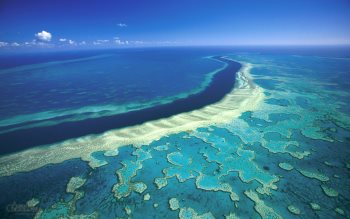
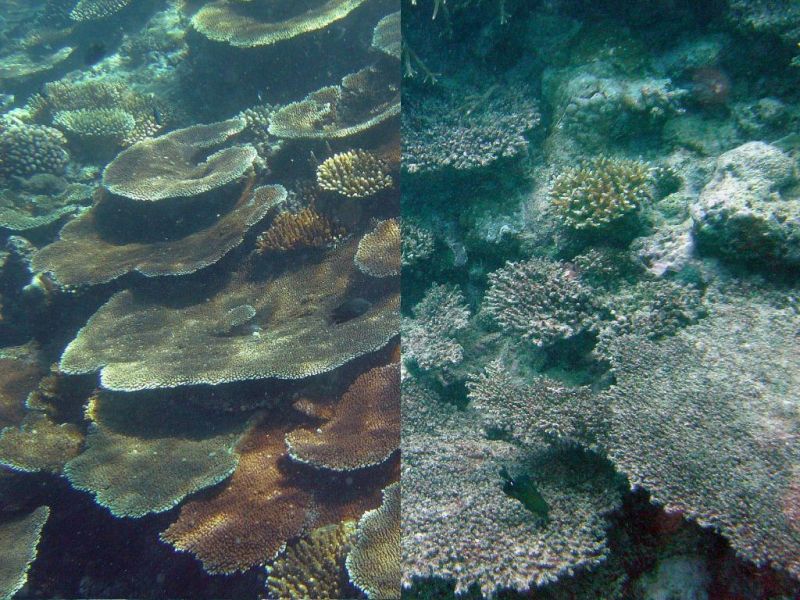
There are hundreds of coral species found in the world’s oceans. There are two types of corals – hard corals, and soft corals. Only hard corals build reefs.

While the majority of coral reefs are found in tropical and sub-tropical water within the latitudes of 30 degrees north and 30 degrees south, there are also deep water corals in colder regions. A flourishing tropical reef is made up of many different plant and animal communities. It is estimated that 800 different coral species are involved in building tropical reefs.

Coral reefs are complex ecosystems supporting a wide array of marine species. The largest and most well-known example of a tropical reef is the Great Barrier Reef in Australia.

Deep Ocean

The deep sea includes the deepest, darkest, coldest parts of the ocean. Eighty percent of the ocean consists of waters greater than 1,000 meters in depth. Parts of the deep sea described here are also included in the pelagic zone, but these areas in the deepest reaches of the ocean have their own special characteristics. Most areas are cold, dark, and inhospitable to us humans, but support a surprising number of species that thrive in this environment.

Estuary

An estuary is the thin zone along a coastline (such as bays, lagoons, sounds or sloughs) where freshwater systems and rivers meet, and mix with a salty ocean, becoming brackish. Sometimes, freshwater from rivers mixes with large freshwater bodies creating a "freshwater estuary" that functions like a typical brackish estuaries.

The five major types of estuaries are coastal plain, bar-built, delta system, tectonic, and fjords.

Hydrothermal Vents

Hydrothermal vents, also in the deep sea, were unknown until about 30 years ago, when they were discovered in the submersible Alvin. Hydrothermal vents are found at an average depth of about 7,000 feet and are essentially underwater geysers created by tectonic plates. These huge plates in the Earth’s crust move and create cracks in the ocean floor. Ocean water enters these cracks, is heated up by the Earth’s magma, and then released through the hydrothermal vents, along with minerals such as hydrogen sulfide. The water coming out of the vents can reach incredible temperatures of up to 750 degrees F. Despite their intimidating description, hundreds of species of marine life thrive in this habitat.

Intertidal Zone

The intertidal zone is the area where land and sea meet. This zone is covered with water at high tide, and exposed to air at low tide. The land in this zone can be rocky, sandy or covered in mudflats. Within the intertidal, there are several zones, starting near dry land with the splash zone, an area that is usually dry, and moving down to the littoral zone, which is usually underwater. Within the intertidal zone, you’ll find tide pools, puddles left in the rocks as water recedes when the tide goes out.

The intertidal is home to a wide variety of organisms. Organisms in this zone have many adaptations that allow them to survive in this challenging, ever-changing environment.

Kelp Forests

Kelp forests occur in cold, nutrient-rich water and are among the most beautiful and biologically productive habitats in the marine environment. They are found throughout the world in shallow open coastal waters, and the larger forests are restricted to temperatures less than 20ºC, extending to both the Arctic and Antarctic Circles. A dependence upon light for photosynthesis restricts them to clear shallow water and they are rarely much deeper than 15-40m. The kelps have in common a capacity for some of the most remarkable growth rates in the plant kingdom.

Mangroves

The term “mangrove” refers to a habitat comprised of a number of halophytic (salt-tolerant) plant species, of which there are more than 12 families and 50 species worldwide. Mangroves grow in intertidal or estuarine areas. Mangrove plants have a tangle of roots which are often exposed above water, leading to the nickname “walking trees.” The roots of mangrove plants are adapted to filter salt water, and their leaves can excrete salt, allowing them to survive where other land plants cannot.

Mangroves are an important habitat, providing food, shelter and nursery areas for fish, birds, crustaceans and other marine life.

Open Ocean

The open ocean, or pelagic zone, is the area of the ocean outside of coastal areas, and where you’ll find some of the biggest marine life species. The pelagic zone is separated into several subzones depending on water depth, and each provide habitat for a variety of marine life. Marine life you’ll find in the pelagic zone includes wide-ranging animals such as cetaceans, large fish such as bluefin tuna and invertebrates such as jellyfish.

Rock Pools and Tide Pools

Tide pools are a unique and brutal habitat where the ocean meets the land. This tidal zone is continually shaped by the actions of sun, wind, water, and rock. The sun bears down, heating exposed surfaces and organisms. Winds blow and contribute to the wave action, erosion, and drying of exposed plants and animals.

Water in the form of waves endlessly pound at the rocks, constantly reshaping the coastline. Rocks are pounded by the waves and loose stones and sand grind into the shoreline.

Life is tough for plants and animals that live in tide pools. Here portions of the shoreline are regularly covered and uncovered by the advance and retreat of the tides. In order to survive, tide pool life forms must avoid being washed away by the tidal waves, keep from drying out in the sunlight of low tide, and avoid being eaten.

Tide pools are subdivided in four zones. They are the splash zone and high tide, mid-tide, low tide areas.

Rocky Shore

Rocky shores are found all over the world. Marine plants and animals that live along these rocky shores have adapted to a habitat that changes every day. In the intertidal zone, water levels along rocky shore may drop 12 feet or more between high and low tide. This means that organisms living on the rocks may be exposed to the air for 10 hours or more between high tides (spray zone). And when the tides roll in, these same organisms must be able to withstand the waves which often hit them with incredible force.

Saltmarsh

Saltmarsh is found on the upper part of the mud, which the sea reaches only when the tide is high. It is covered  in plants that can cope with salt and with being regularly  underwater. 

Salt marshes start life as mudflats. In areas of sheltered  water, like a harbour, the sediment held in the water settles  out and builds up. As plants arrive and grow their roots help  to stick the mud particles together and trap even more sediment  so the mudflats become more stable. As the mudflats build up, 
different types of plants can grow and live there creating a salt marsh  habitat made up of blocks of flat low growing vegetation with narrow channels between.

Sandy Beaches & Mud Flats

The sandy beach is a harsh, constantly changing environment. Waves and currents build up and wash away sand. Plants and animals that live on the open beaches must be adapted to living in a hot, exposed and fluctuating habitat. Over a day their home has changes in salinity, water pressure, moisture, light, oxygen and food availability. Not only is the change daily but months, seasons and years shape and remake the open beach environment.

The most obvious things on the open beaches are the flotsam and jetsam, ie dead material and rubbish. But there are many creatures living in the sand. What lives on and under beaches depends on how the beaches are composed. Sand particles vary in size, structure and mineral content. This in turn affects the shape, colour and inhabitants, of the beach.

Mudflats are a very important habitat for all sorts of wildlife as well,  especially wading birds and wildfowl. The mud flat environment is full of nutrients  and also has a wonderful store of invertebrates, shellfish and other  amazing creatures (plankton) that are so small they must be looked at through a microscope.

Seagrass

Seagrass is an angiosperm (flowering plant) that lives in a marine or brackish environment. There are about 50 species of true seagrasses worldwide. Seagrasses are found in protected coastal waters such as bays, lagoons, and estuaries and in both temperate and tropical regions. Seagrasses attach to the ocean bottom by thick roots and rhizomes, horizontal stems with shoots pointing upward and roots pointing downward. Their roots help stabilize the ocean bottom.

Seagrasses provide an important habitat to a number of organisms. Some use seagrass beds as nursery areas, others seek shelter there their whole lives. Larger animals such as manatees and sea turtles feed on animals that live in the seagrass beds.

Seamounts

Seamounts are undersea mountains (usually of volcanic origin) rising from the seafloor and peaking below sea level. A seamount tall enough to break the sea surface is called an oceanic island, e.g., the islands of Hawaii, the Azores and Bermuda were all underwater seamounts at some point in the past.

Sponge Gardens

These habitats flourish in shaded or deeper water as they are not dependent on sunlight as algae and seagrasses are. Not only do sponge gardens provide important habitat for other animals, they are an important part of nutrient cycles in the marine systems - filtering out particles and nutrients from the water as they feed.

Back to top

 
Home  |   News  |   Meetings  | Courses  |  ContactsMarine Sciences  |  Things to do | Marine World News | Sitemap |